Permanent archive copy
Originally published by The Escapist on 10 September 2026. Preserved here by the author for long-term access.
There are console launch games that demonstrate just what a step up the new hardware is offering, and there are console launch games that make you feel a bit better about the small fortune you just spent on it because you can’t stop playing ’em. In 2000, SSX managed to do both things at once. And that, my friends, is a rarity.
The PlayStation 2 arrived with plenty of recognizable names. Tekken Tag Tournament was there. Ridge Racer V was there. EA had Madden and FIFA. Yet one of the games that most effectively announced that we were ushering in a new golden era in gaming was a snowboarding game with no famous snowboarders, no official championship license and courses that rapidly abandoned any notion of behaving like actual mountains.
Step forward SSX – even all these years later, a game I still go back to when I need a little joy in my life.
While later entries, particularly SSX Tricky and SSX 3, would refine the formula and arguably eclipse it, the original deserves to be remembered as far more than a prototype for what came afterwards. SSX was one of those rare games where technology, design and timing collided almost perfectly. It arrived just as extreme sports games were exploding in popularity, just as a new generation of hardware allowed developers to think considerably bigger, and just as Electronic Arts was prepared to loosen its tie and behave a little less like Electronic Arts.
Twenty-six years later, booting up SSX, either on OG hardware or the excellent PS2 emulator (opens in a new tab), still provides an immediate reminder of something games these days seem to have completely forgotten: realism and fun are not necessarily the same thing.
SSX understood the sport of snowboarding and made it bigger and brasher than it could ever be in real life, and that’s what made it the f word – fun.
Before SSX, snowboarding games already existed
Electronic Arts certainly didn’t invent virtual snowboarding. Sony’s Cool Boarders series had been successful on the original PlayStation, while Nintendo’s 1080° Snowboarding remains one of the Nintendo 64’s finest sports games. Snowboard Kids had taken the sport in a more playful direction, too.
Then, in 1999, Tony Hawk’s Pro Skater changed the wider action-sports landscape completely, and to this day, we are still getting clones, as you can see in my recent interview with social media star skateboarder Sterre Meijer (opens in a new tab).
Suddenly these sports did not need to be translated into conventional simulations. They could be videogame systems in their own right: combos, shortcuts, secrets, enormous scores and an attitude that was as important as whatever real-world activity was supposedly being recreated. Fighting games had made combos a real-world thing, so why not add them to sports games?
SSX arrived in that environment, but its origins can be traced back via gaming DNA considerably further.
Its creator and executive producer, Steve Rechtschaffner, had been a competitive skier before moving into television and marketing. While working on Greg Stump’s World of Extremes at Blackcomb in 1991, Rechtschaffner helped devise boardercross, putting multiple snowboarders on a course simultaneously and effectively combining snowboarding with the aggressive racing structure of motocross.
The snowboarders apparently weren’t particularly convinced by it initially. Rechtschaffner later recalled that once six riders actually went down the first course together, however, they reached the bottom laughing and high-fiving. Boardercross eventually evolved into the Olympic snowboard cross discipline. Years later, its videogame potential was obvious.
At EA Canada, Rechtschaffner had worked on FIFA and the Triple Play Baseball series before finally getting the opportunity to build his snowboarding idea. Former SSX developer Scott Henshaw recalled a surprisingly scrappy beginning for a game that would eventually become one of EA’s flagship releases, with a small team being assembled in rented space and staff installing network cabling themselves. I think we have all been there.
The designers studied existing snowboarding games, including 1080°, but one particularly important influence wasn’t a snowboarding game at all: Atari’s San Francisco Rush: Extreme Racing. Producer Larry LaPierre and Henshaw were such fans of its huge jumps, alternative routes and arcade mentality that linked Rush cabinets reportedly ended up in the office.
Playing SSX today, armed with the fortune of insider knowledge, you can start to see the game for what it really is. SSX is really a racing game that just happens to use snowboards.
Building a PS2 game before anyone really knew the PS2
Development began around two-and-a-half years before release, which presented the team with a rather obvious difficulty: much of the hardware they were targeting didn’t properly exist yet.
Rechtschaffner told GameSpot at launch that the developers initially worked in a PC environment, using powerful machines and making educated guesses about what Sony’s forthcoming console would eventually be capable of. The physics system alone received around a year of work before release. Once PlayStation 2 development kits arrived, the additional power actually caused EA Canada to rethink how its courses were constructed and they managed to make SSX’s tracks feel absolutely enormous in 2000.
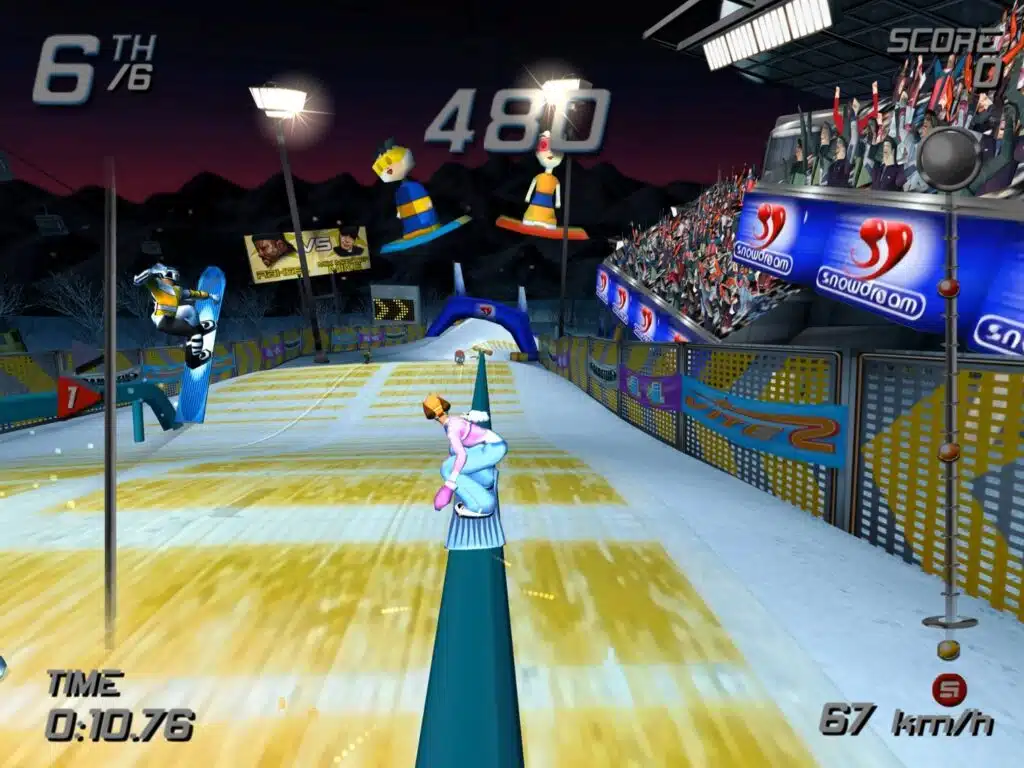
Snowdream initially resembles something approaching a conventional downhill course, gently teaching you that practically every ridge is an invitation to leave the ground. Then the game begins dismantling your reality.
Elysium Alps sends riders hurtling across enormous drops. Merqury City Meltdown – yes, SSX really did spell it “Merqury” – turns a frozen city into a racetrack, sending you through buildings and across urban infrastructure. Mesablanca somehow combines snowboarding and sun-baked desert scenery.
Then you reach Tokyo Megaplex and any remaining pretense of normality disappears entirely.
TM is less a snowboard course than a gigantic neon pinball machine, complete with mechanical obstacles and enormous fans throwing riders around the arena. Aloha Ice Jam takes place across an enormous disintegrating iceberg, while Pipedream essentially transforms an indoor snow park into one huge trick playground. Complete everything and Untracked provides the opposite experience: a relatively natural mountain covered in powder where you are simply allowed to choose your own route. The original game’s manual lists eight venues in total.
Modern games might construct entire mountains, indeed SSX’s later iterations would do exactly that, but SSX understood that scale doesn’t necessarily mean square mileage. Its courses are packed with decisions. Go through the tunnel or over it? Follow the obvious corner or throw yourself over that suspicious barrier? Is that gap actually jumpable? It just might be…
Tricks weren’t something you did instead of racing
Out of everything, SSX’s cleverest idea was the boost meter, filled up by doing daft tricks.
Most racing logic tells you that unnecessary movement is bad. Take the racing line. Avoid obstacles. Don’t spend five seconds spinning through the air when you could be travelling towards the finish. That’s how we have been brainwashed into playing racing games in 2026. Fun is merely short for functional.
Performing tricks fills an adrenaline meter that can then be burned as additional speed. Consequently, showing off isn’t separate from racing; it is part of racing. Want to go faster? Do something really stupid first and catch up the time you lost doing it with a boost.
It creates one of gaming’s most glorious feedback loops. Bigger air allows bigger tricks. Bigger tricks provide more boost. More boost gives you additional speed, which lets you hit ramps harder and get even bigger air.
It is difficult to overstate how important that was to SSX’s character. Racing and trick modes existed separately, but the underlying mechanics constantly encouraged players to blur the two. Contemporary reviews picked up on it immediately, with GameSpot particularly praising the way SSX combined racing and trick performance rather than treating them as isolated systems.
That balance is also why the controls still feel so satisfying. You can understand SSX almost immediately, but understanding a course is different from mastering it. Learning where you can take risks, where shortcuts hide and how much rotation you can squeeze out of a jump gradually changes your relationship with every track.
Shake what your mama gave ya
And then there was the music.
Plenty of games had licensed soundtracks by 2000. SSX did something substantially more interesting with its own audio, although you may not even have realised it at the time – its music reacted to your performance.
Race well and the soundtrack would become fuller and more aggressive. Start struggling and musical elements could disappear from the mix. Catch serious air and the music would recede, temporarily leaving the wind and the sensation of hanging impossibly high above the course before everything crashed back in when your board touched the snow.
Reviews highlighted the system as one of SSX’s defining technical accomplishments. Songs were specifically arranged so elements including vocals, bass, guitars and scratching could be mixed dynamically depending upon what was happening during a race. The soundtrack included contributions from Mix Master Mike, Rahzel and drum-and-bass artists including Aphrodite.
It sounds like the sort of feature publishers would advertise as revolutionary today but back in 2000 it was just a ‘nice to have’ sitting inside a PS2 launch game.
The soundtrack also helped establish what eventually became the EA Sports BIG identity. This wasn’t simply EA Sports with exaggerated physics. It had its own visual language, music and attitude.
Rechtschaffner said the game was deliberately designed like an arcade machine. The developers effectively imagined there was a coin slot attached to the PlayStation 2: if anything became boring enough that somebody might stop inserting money, it needed to change.
EA Sports BIG was born on the mountain
It is strange looking back at Electronic Arts during this period because experimentation was happening everywhere.
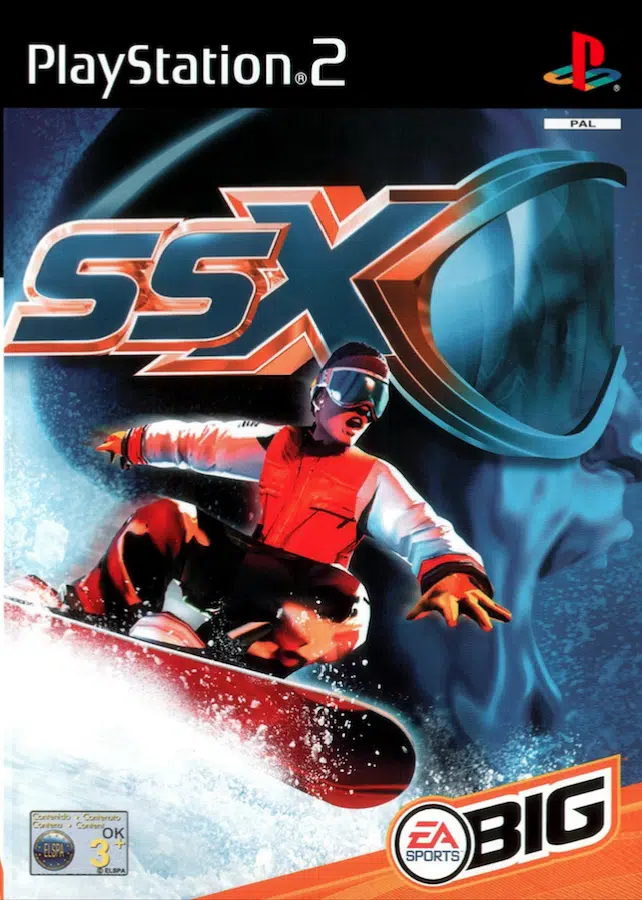
SSX became the first release under the newly created EA Sports BIG label, effectively providing the blueprint for an entire family of games. Rather than competing directly with EA Sports’ simulation-focused franchises, BIG would exaggerate sport until it became something closer to fantasy. You can tell how uncomfortable it was at first in the game’s cover, which didn’t really do anything to indicate the madness inside. By the time SSX Tricky came around, though, EA was fully in.
NBA Street followed. Then came games such as FIFA Street, NFL Street, Freekstyle and another wonderfully over-the-top take on Sled Storm.
Rechtschaffner later described the desired balance as “plausible but fantastic.” The underlying physics needed enough consistency for players to understand them, but there was no reason a videogame needed to respect the physical restrictions of an actual snowboarder.
So why shouldn’t you clear a gigantic canyon? Why shouldn’t a race travel through a city? Why shouldn’t somebody build a snowboard course inside a machine resembling an industrial pinball table? The answer was always the same.
Because it would be fun.
Then Tricky arrived and stole its thunder
Perhaps the strangest part of the original SSX’s legacy is that it was almost immediately overshadowed by its own sequel. SSX Tricky arrived in 2001, bringing remixed courses, even more absurd Uber Tricks, Run-D.M.C.’s It’s Tricky, a larger cast and celebrity voice actors including David Arquette, Lucy Liu and Billy Zane.
For many players, probably me included, Tricky became SSX. Even though I was Editor of PlayStation Pro magazine at the time, I remember taking the press copy home at night and doing disc swap tricks to get it working because I didn’t have a blue dev machine at my house, only in the office.
Then SSX 3 appeared in 2003 and produced another legitimate contender for the greatest snowboarding game ever made, turning the individual tracks into a connected mountain that players could descend in spectacular continuous runs.
But almost everything that made those games special can be traced back to decisions made in the original.
Critics recognized it at the time. SSX currently holds a Metacritic score of 93 from 35 reviews, putting it among the most acclaimed titles of the PlayStation 2’s first year.
Its awards record was even more impressive. At the Academy of Interactive Arts & Sciences’ 2001 Interactive Achievement Awards, SSX won five categories: Console Game of the Year, Console Racing, Console Sports, Gameplay Engineering and Visual Engineering. Tony Hawk’s Pro Skater 2, Final Fantasy IX, Shenmue and Jet Grind Radio were among the games it was competing against.
Not bad for EA’s weird new snowboarding game.
We have been waiting far too long for another one
The painful part is knowing where SSX eventually ended up.
SSX On Tour followed in 2005 and SSX Blur arrived on Wii in 2007 before EA attempted a full revival with SSX on PlayStation 3 and Xbox 360 in 2012.
That game wasn’t bad at all. Parts of it were excellent. But the combination of deadly descents, survival mechanics and a slightly more serious presentation never quite recreated the carefree lunacy of the PS2 games.
There hasn’t been another official SSX since and it’s quite possible there never will be – unless EA finds a way to crowbar Ultimate Team into it. Can you imagine? Sadly, I probably can.
Rechtschaffner and LaPierre later reunited at SuperNatural Studios to develop Project Gravity, intended as a spiritual successor built around accessible arcade snowboarding. 2K was attached as publisher before withdrawing from the project, and concept art subsequently surfaced showing tantalising glimpses of what might have been.
Perhaps that continuing interest explains why SSX still occupies such a peculiar place in gaming nostalgia. Other snowboarding games have appeared. Ubisoft’s Steep provided huge mountains. Riders Republic threw practically every extreme sport it could find into an open world. Smaller developers continue attempting to revive arcade snowboarding – Tricky Madness is a half-decent homage. Yet nothing feels quite like SSX. Sad face.
The PlayStation 2 would eventually receive bigger games, prettier games and considerably more sophisticated games, but during those first weeks in 2000, SSX did something more important.
It showed us what the new machine could be and made us shake what our mama gave us.