Permanent archive copy
Originally published by The Escapist on 11 February 2026. Preserved here by the author for long-term access.
Retro hardware is having a moment again, but most of it feels disposable: plastic plug-and-play boxes built for one weekend of nostalgia before they’re shoved into a drawer forever. throwaway electronic waste. Atari knows that. And with the Intellivision Sprint, the company is making a very deliberate argument that authenticity still matters, not as retro cosplay, but as preservation.
When I spoke to Matthew Burnett, Atari’s Vice President of Strategic Operations, and David Lowey, Senior Director of Marketing Communications, what came through most clearly was that Sprint isn’t designed to be a novelty. It’s meant to feel like the real thing, because for people who grew up with the Intellivision, like myself, that “real thing” isn’t just hardware. It’s memory.

Burnett puts it bluntly: when you pick up that controller again, “it has to feel like the original. It has to bring you back to those memories, and if it doesn’t, then we haven’t really done our job.”
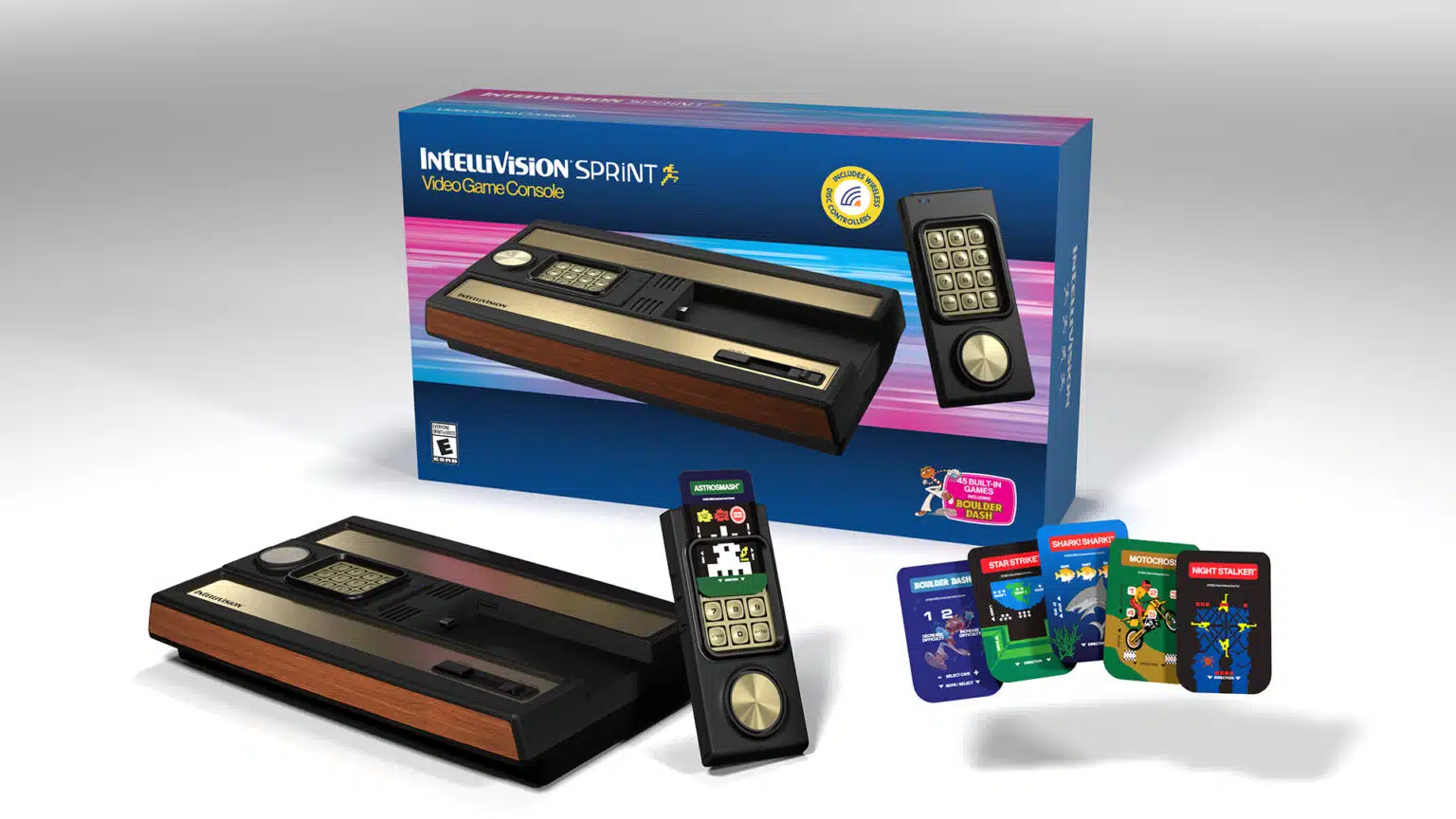
That’s the guiding principle behind Sprint, a modern, HDMI-friendly way to play Intellivision that doesn’t sand down the weirdness that made the machine special in the first place.
The console that started it all (for some of us)
I told the team straight away: I’m not just retro-curious, I’m an Intellivision lifer. I’ve spent longer locked in a room with an Intellivision than if I had murdered somebody. It was my first console as a kid, and one that became tangled up with family ritual. Sunday afternoons of Sub Hunt, Bowling, Tron Deadly Discs, and the kind of shared couch gaming that feels almost alien now. It doesn’t exist and probably never will again.
When my parents passed away, I found myself buying the console back, chasing those memories. That quickly turned into full-blown collecting, until reality hit, somewhere around game number 89, when the remaining titles started costing $1,000, and the dream collapsed under scalper economics.
Sprint, then, isn’t just another reissue. It’s something closer to what Burnett calls “a moment of joy connection” – a way to play Intellivision as it actually felt, without risking ageing original units that could die at any moment. Units which were never imagined to be desirable are getting on for 50 years later.
As I put it to them: Atari has “provided a means to play Intellivision in the way that I remember playing Intellivision without an Intellivision. No one’s got close to pulling that off before.”
Why legacy hardware is harder than it looks
Atari’s modern hardware push has been building steadily: the 2600+, the 7800+, the VCS experiment. But Intellivision is a different beast, because its identity isn’t just in the box, it’s in the controller.
Burnett admits rereleasing legacy machines is a tightrope. “People like you that have grown up with this, they have a real connection for that device,” he says. “If you start removing those elements… you’ve lost the connection with that joy.”
That’s why Sprint keeps the iconic design language: the woodgrain, the angles, the metal plates. Burnett even flips the unit over mid-call, laughing at how much the original Intellivision borrowed from Atari’s own 2600 silhouette. “It kinda looks like a 2600, doesn’t it?”
And crucially: those plates aren’t cheap plastic pretending. “There was no question about whether or not we’re going to spend the extra money… it’s not going to be plastic, it’s not going to be painted. This is going to be metal.”
The controller problem (and why it had to stay weird)
The Intellivision disc controller remains one of the strangest controllers in gaming history – a love-hate object even among fans. But Atari understood that if they didn’t nail it, nothing else mattered.
As I said: “If you hadn’t nailed the controllers… everyone would have been like, well, this isn’t how I remember it.”
Burnett agrees completely. The disc had to be the same size. The overlays had to fit. The whole point was fidelity, not reinvention. He points out that certain games – Shark Shark, for instance – only work because of that fluid disc movement. For me the same applies to the likes of Tron and Imagic’s excellent Dracula – another huge McNally family fave from the early 80s.
The compromise wasn’t redesigning the controller into something safer and easier to produce. It was modernising around it: wireless tech, USB-C charging, and a form factor that works in a modern living room without needing “a cord the size of the console itself” to reach a 70-inch OLED.
Overlays, muscle memory, and fighting the scalpers
One of the most unexpectedly passionate parts of the conversation was overlays – those flimsy plastic inserts that modern collectors now hoard like artefacts.
Burnett is visibly annoyed that community members are charging $5 a pop for scraps of plastic. “That’s crazy,” he says. Atari is working on replacement packs “at a very reasonable price,” partly to undercut scalpers and partly to keep the ecosystem alive.
They even had to redraw dozens of overlays from scratch because, as Burnett jokes, “guess what didn’t exist forty years ago? Vector.”
This is what Atari means by authenticity: not fetishising the past, but doing the work to keep it playable without exploitation.
A living ecosystem, not a static throwback
Perhaps the most important philosophical point Atari makes about Sprint is that it isn’t meant to be frozen in amber.
Burnett calls these consoles “living, growing ecosystems,” driven not just by legacy ROMs but by homebrew, unreleased prototypes, community ports, and sideloading.

Lowey contrasts this directly with the Flashback era: devices built for “a long, fun weekend” before being abandoned. Sprint is meant to last. The UI even presents sideloaded games “as if they’re sitting on the machine itself.”
That matters, because Intellivision’s future isn’t just nostalgia – it’s the weird, dedicated community that never stopped building for it.
How do you sell Intellivision to a 20-year-old today?
This is the question that hangs over every retro revival: are these machines only for people like me? I mean, I am great, but I cannot sustain a business.
Burnett thinks the answer is partly simplicity. Modern gaming is all profiles, DLC, grinding, and endless systems. Sprint offers something else: “You turn the thing on, you play games, and then you turn it off, and you move on.”
But he also thinks relevance matters. You need software, an IP that sparks curiosity. He jokes about a hypothetical Wednesday Addams game pulling younger players in.
Lowey adds that exposure does the rest. When Atari brings these machines to shows, kids “lock in” for 20 or 30 minutes because the pick-up-and-play immediacy is almost shocking to them now.
And the Intellivision catalogue still has teeth: baseball’s first stealing mechanic, hockey’s first fighting and penalties, football’s hidden playbook complexity, and Utopia – arguably one of the earliest god-game ancestors.
Preservation over cheap emulation
What about the flood of cheap handheld emulation devices?
Burnett isn’t worried. Atari isn’t competing on volume; it’s competing on quality and connection. “We’re really targeting people that care about the look and feel and the quality of the product,” he says.
Lowey frames it more broadly: Atari focuses on what it does well – authentic hardware – while licensing partners handle arcade cabs, handhelds, and other form factors. The existence of knockoff devices is, if anything, proof of demand.
And if people are playing old games at all? Burnett sees that as a win.
“At the end of the day, we want people to play great games.”
What’s next for Sprint
Burnett does spill one genuinely exciting detail: Atari is building an adapter that will let players plug original Intellivision II DB-9 controllers into Sprint, using the USB ports already sitting on the back of the unit.
Overlay packs are coming too, alongside more games delivered via USB ecosystem expansions.
The point is clear: Sprint isn’t the end. It’s the beginning of Atari treating Intellivision as something worth actively supporting again.
As Burnett puts it, “We are game preservationists at the end of the day… it’s important that the history and the feel and the community around all of these products are happy and they never get lost in time.”